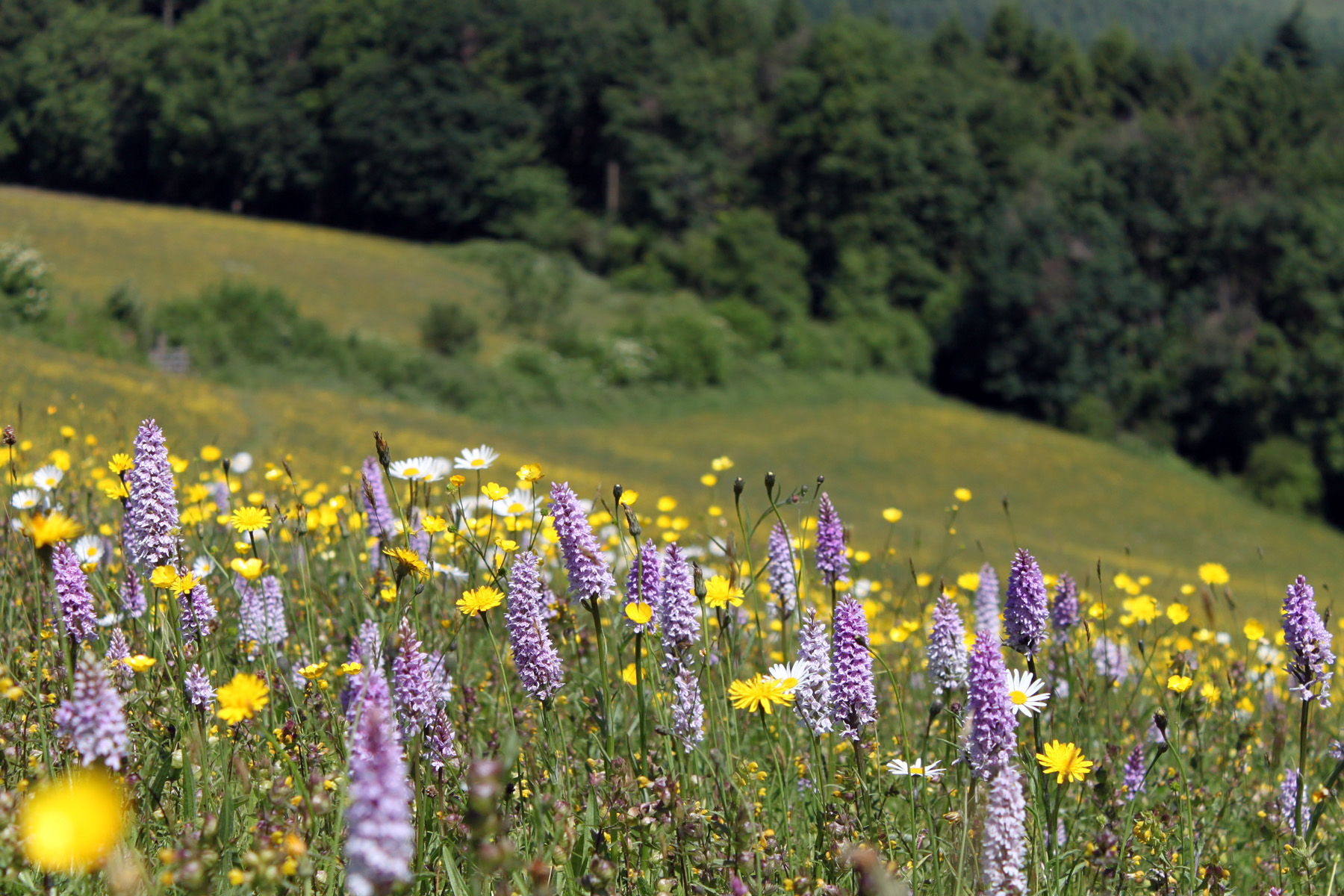

If you follow us and our activities, you might remember our recruitment campaign for Meadow Monitors back in April– a call for volunteers to help us assess the progress of meadows restored through the 2021 Meadow Makers project. Thanks to Jules Agate, and the fantastic response from our community, that call quickly grew into the fully fledged and super efficient Meadow Monitors 2025 – a citizen science project bringing together 19 enthusiastic and inspiring volunteers with a shared passion for botany and conservation. Following the launch event at the end of May, which gave everyone the opportunity to meet each other and refresh their rapid monitoring and plant id skills, the group have spent a long and very hot summer visiting our county’s species-rich grasslands, gathering data and insights, to help us understand how our restoration efforts are progressing.
How it All Began
The Meadow Makers 2021 was a national project led by Plantlife and supported by DEFRA’s Green Recovery Challenge Fund. As one of the 7 regional partners, we engaged 26 local landowners and quickly set to restoring 71ha of Herefordshire grassland. This effort amounted to 18% of the 400ha restored nationally! All the participating landowners committed to a 10-year plan of post-restoration management and surveys, ensuring the long-term success of their meadows. With any restoration effort, it is essential to monitor progress, learn from mistakes, and guide future management decisions. Drawing on experience from our other projects, we knew that a four-year interval is an effective timeframe to assess the success of reseeding and overall meadow recovery.
Restoration is Working!
Between June and August, 45 separate Meadow Makers field parcels were surveyed using the rapid plant monitoring method. After painstakingly downloading and analysing the data, using an approach developed by the County Botanical Recorder and Herefordshire Meadows Trustee Stuart Hedley, we have been able to extract some provisional results from the information collected. Across all the sites surveyed the number of desirable broad leaved herbs present has increased from 5.9 to 13.5 – a 128% increase. The average abundance of desirable broad leaved herbs has improved even more from 1.9 to 5.7 species per m2 – a 200% increase. Additionally, 8 of the field parcels have been submitted to Natural England for inclusion on their Priority Habitats Database.

Why the Meadow Monitors Matter
A big part of the project, and something we really care about, is strengthening and empowering community involvement. We connect people and meadows. Our volunteers bring fresh ideas, energy, and experience. They help us maintain positive relationships with land managers, and inspire their communities. In the process, they greatly expand our capacity for surveying and monitoring and highlight the vital role of citizen science in UK biodiversity conservation. We are so incredibly grateful for their contribution and for supporting our work. Thank you!

Looking to the Future
We have already made plans and first steps to replicate the process in 2026, revisiting the 2022 & 2023 restoration sites. We will continue to support our volunteers with plant identification training and refreshers, and dutifully use their feedback to adapt and improve our surveying procedures. We might even delve into the soil health assessment training next season, to complete the holistic view of grasslands. There is so much to look forward to, we are excited for the 2026 already!
