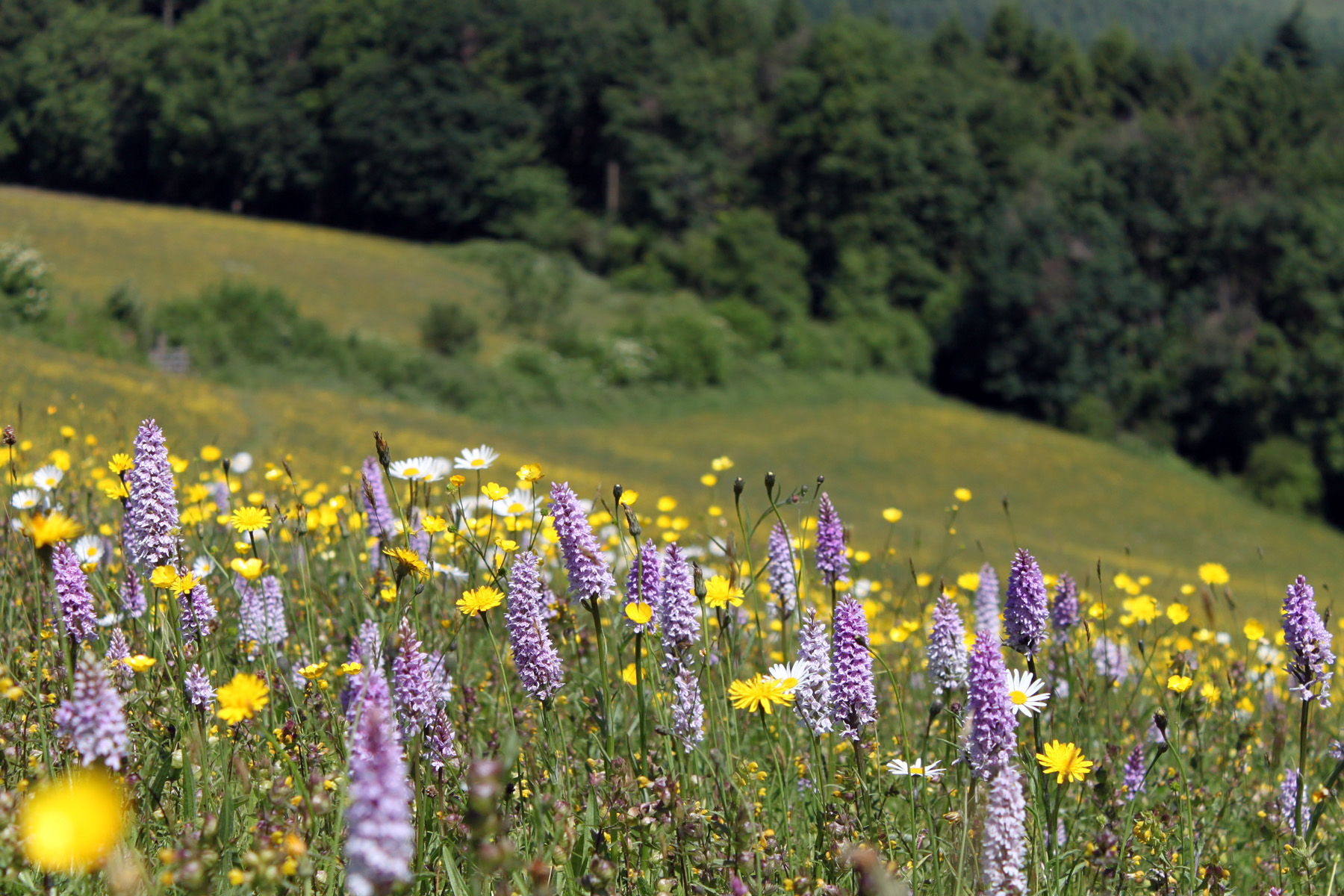

There was a great turnout for our Annual Forum on Saturday 28th Feb, which this year had the theme ‘Healthy Grasslands, Healthy Livestock’.
A warm welcome by our Chair of Trustees Lyn Langford was followed by an overview of our achievements in 2025, and our project, advocacy and fundraising plans for 2026.
One of our proudest achievements over the last year has been the launch of our Meadow Monitors volunteer program. This program saw volunteers trained in plant ID and survey methods, revisiting restoration sites we supported in 2021 to monitor their progress. Meadow Monitor Charlie Finnigan spoke eloquently of his experience as a citizen scientist, visiting beautiful meadows, learning new skills, and contributing to an important dataset demonstrating the success of grassland restoration.
Our guest speaker Dr Claire Whittle, the “Regenerative Vet” gave a fascinating talk about her experiences as a vet and farmer, employing the powers of diversity for animal health and environmental benefits – a passion kick-started after reading Wilding by Isabella Tree.
We took a deep dive into importance of dung beetles in the ecosystem, and indeed of the dung itself. With a single cow pat able to support 1000 developing insects, rich pickings for the UK’s 60 species of dung beetle (most of which are endangered). Dung beetles fertilise the land by digesting, and sometimes transporting underground, the liquid portion of droppings, making its nutrient content more easily available for surrounding plants. Their activity can also make the dung less hospitable to ‘problem’ species, such as parasitic flies and worms that prey on livestock – but unfortunately dung beetles are being killed by the very drugs that farmers use to control those pests – Avermectin-based wormers.
Claire showcased methods that can be used to support this rich dung-based ecosystem through more mindful use of wormers, and utilising the powers of diverse grass, diverse habitats, less reliance on grain feed, and careful movement of animals. There is lots more information about the importance of dung beetles and how to support them here.
Claire went on to demonstrate the many other benefits of diverse grasslands and landscapes, with examples from her own farm in North-East Wales. Claire has spent the last few years making improvements such as extended rest-periods for grasslands, and planting hedges and shelter belts to provide nutrient-rich browsing and shelter in extreme weather conditions. Features like this are likely to prove particularly beneficial in the face of climate change.
Claire’s talk was followed by a discussion with a Panel of local farmers; Dreda Darling from Caradoc Farm, Ed Dickson from Lower House Farm and Mark Wood from Clay Estates.
The Q&A discussion touched on a whole range of subjects from education and access, consumer preferences and purchasing power, farm resilience and more. All the panellists are looking at how they can enhance the natural assets of their farms and are using grazing livestock as a tool to support this by improving soil health and managing species rich grasslands.
The need for a change in the culture of food production and consumption was highlighted. Something we can all contribute towards by promoting healthy grass fed systems and their benefits to the environment, the animals and our own health. Whilst things are moving in a positive direction, the panellists all agreed that there was still a more work to be done to connect people to farms and nutritious good quality food.
Practicing what we preach we rounded the event off by serving a delicious hot lunch of stew made with grass-fed beef from Perrystone Meats.
