
On Wednesday 23rd July we held our final Meadow Walk of the season, with poly-naturalists Ian and Ruth Draycott.
It was a truly fascinating session, exploring the distinctive ecology of the Doward – an area where ancient geology supports a remarkable diversity of life, with over 5000 species recorded! We were particularly inspired by the two examples of rare calcareous grassland; Ian’s and Ruth’s site being a great lesson in how relaxing our urge to control nature can lead to the flourishing of specialist species, such as the rare clary sage found in the limestone pavement.


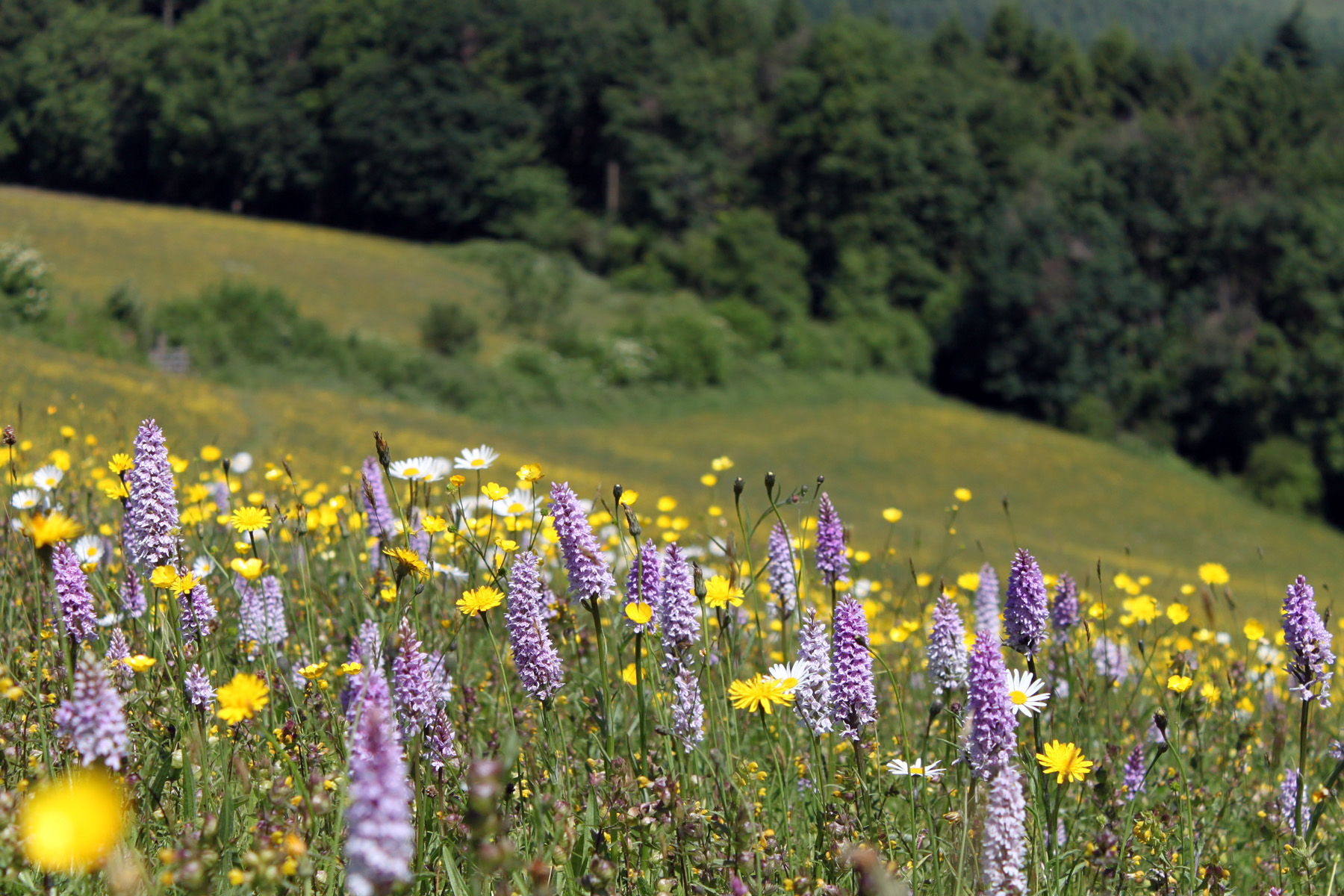
A photo of the meadow at White Rocks Cottage, by Ruth Draycott.
A perfect follow-up to our walk is, of course, Ian’s book The Biodiversity of the Doward and Symond’s Yat West, available via the Herefordshire Wildlife Trust website. In the meantime, here is a summary of some key conversations from our walk, along with a few additional resources.
Plant Encounters: rare finds and tricky pairs
- In the Woodside reserve, we came across Wood Barley Hordylemus europeaus (rare perennial) which is different from Wall barley Hordylemus murinum (a common annual grass)
- We talked about Whitebeams Sorbus aria vs Wild Service trees Sorbus torminalis, and learnt that two unique species of Whitebeam (Sorbus herefordensis) are endemic to the Doward’s Miners Rest reserve
- In the dampish woodland glade we saw Marsh Thistle Cirsium palustre, statuesque and quite solitary (biennial, not invasive) and compared it to Creeping Thistle Cirsium arvensis, bane of many a farmer (perennial, can be invasive)
- Common Agrimony Agrimonia eupatoria (decorative leaves and yellow spike of star shaped flowers) and Hemp agrimony Eupatorium cannabinum (tall, with off-white or pinkish flowers) were both spotted in the glade. Similar names, completely different plant families!
- Wild Basil Clinopodium vulgare – native and safe to eat but quite distinct and not with the same aroma as culinary herb basil Ocimum sp.
Dead Wood – alive with biodiversity
We also discussed the vital ecological role of dead wood – a key habitat for saproxylic beetles, rare hoverflies, and saprophytic fungi. Beyond biodiversity, dead wood also provides natural seating for weary walkers and artistic inspiration for those who pause to notice – we need it in our woodlands! The Severn Treescapes offshoot Dead Wood Society can be found here:A new branch for Severn Treescapes | Worcestershire Wildlife Trust
Grazing and management
As usual, part of our focus was on the practical aspects of grassland and habitat management. For those interested in exploring virtual fencing, see What is Nofence? – this innovation is used for conservation grazing by Wildlife Trusts, Epping Forest Heritage Trust and many others.
A subject of willow for sheep was raised, in scrubland and sylvopasture. Slightly outside our remit, but fascinating nevertheless, please see Soil Association research on Feeding willow to lambs: Results from Innovative Farmers field lab – Agricology
We would like to express our thanks to Ruth and Ian for hosting us and inspiring us with their achievements and passion. To everyone, thank you for joining us and contributing to such a thoughtful and inspiring afternoon. We hope to see you again for future walks and events!
If there are topics you would like us to cover in the future, please let us know. If you need further help and guidance for your grassland, please get in touch with us or request an advisory visi. If you enjoyed the visit and would like to donate to Herefordshire Meadows to support our programme of events and work please click here.


A photo of the meadow at White Rocks Cottage, by Ruth Draycott.
This event was provided thanks to donations from our supporters to the Herefordshire Meadows Community fundraiser, and match funding from the Big Give Green Match Fund 2025.
