
On Wednesday 7th January, we held our Annual General Meeting. You know you have expanded as an organisation when the car park of your usual village hall venue is full to the brim fifteen minutes before the event’s start time. With a promise of a great talk and grass-fed beef buns from Perrystone Meats, everyone was keen to secure a seat!
This year marks our ten-year anniversary since the formation of the original Herefordshire Meadows Farmer Facilitation Group. Over that time, we have grown in team members, in reach, and in the scope of our projects. Thank you to our CIO members and supporters for being with us every step of the way.
Our guest speaker for this annual event was Graham Harvey– author, long-term agricultural story editor for The Archers, and co-founder of the Oxford Real Farming Conference. Graham’s talk, titled ‘The Greatest Story’, explored the slow 50+ years corporation-driven shift from mixed farming to input-driven, specialised agricultural production systems, motivated predominantly by yield, and increasingly disconnected from nature. The catalyst for this change was the Green Revolution and the Liebig’s Law of Minimum, which shifted the focus of agriculture from traditional methods to a precise, industrial model of chemical nutrient management, and elevated synthetic nitrogen to the most influential agricultural input.

As with any thought provoking talk, a wide range of books and papers were referenced for inspiration, evidence, and debate. Among them was ‘The Farming Ladder’ (1944) by George Henderson, a longstanding influence on Graham’s thinking. The book recounts the rebuilding of a rundown 87-acre farm in the Cotswolds during the 1920s, and tripling soil fertility through livestock grazing. Discovering examples such as this is a reminder that there is little new under the sun, and that regenerative practices, including rotational grazing, attention to the carbon cycle, and stacking enterprises, have been tried and tested before. Small does not mean unproductive, and Henderson’s experience demonstrated that a mixed farm can indeed be profitable.
Ground breaking research conducted by Professor Andrew Neil in 2020 on the role of carbon in soil health was quoted, and the Victorian-era switch from manure to ammonia and phosphorous based fertilizers which caused soil microbiology to metabolise more carbon, excrete less polymers and fundamentally alter the properties of farmland soils when compared to their original grassland state, affecting their water storage capacity and reducing resilience in extreme weather events.
Changing a system built upon dependence on inputs is not straightforward and the ‘Farming at a crossroads: how farmers are navigating the agricultural transition’ 2025 report by the Green Alliance was referenced during the talk. This report presents findings from visits to six farms across England, representing a range of farming systems, sizes, and tenancy types. Drawing on these visits, the report sets out nine recommendations for how government agricultural policy could better support farmers through the agricultural transition.
‘The Agricultural Dilemma- How not to Feed the World’ by Glenn Davis Stone was another key text quoted by Graham – a critical analysis of global food systems, their reliance on overproduction and dependence on external inputs. The responsibility of feeding the world is a heavy burden which many of our farmer members feel – we deeply sympathise with that pressure of duty. The regenerative farming movement however offers an alternative perspective, captured by Gabe Brown in the film Kiss the Ground (2020): “You don’t have to feed the world – you just have to feed your community.”
This is exactly the approach we strive to enable in our work – we offer support and inspiration to our local farming community to make their transition to nature friendly farming smoother and less worrying. We advocate for the role of meadows in viable farming systems and for the benefits to human and environmental health they provide. We educate the public on challenges of grassland restoration, and create local, meadow-centred connections between farms and members of the public, to build trust and mutual understanding.

What particularly inspired us to invite Graham to speak to the Herefordshire audience, aside from his lifelong engagement in agriculture journalism, was his book ‘Grass Fed Nation: Getting Back the Food we Deserve’. The book advocates for the return to pasture- fed meat, dairy and eggs as solutions for restoring environmental and soil health. It emphasizes the role of species-rich grasslands for the quality of forage they provide and the desperate need to protect and restore them for our own survival and health.
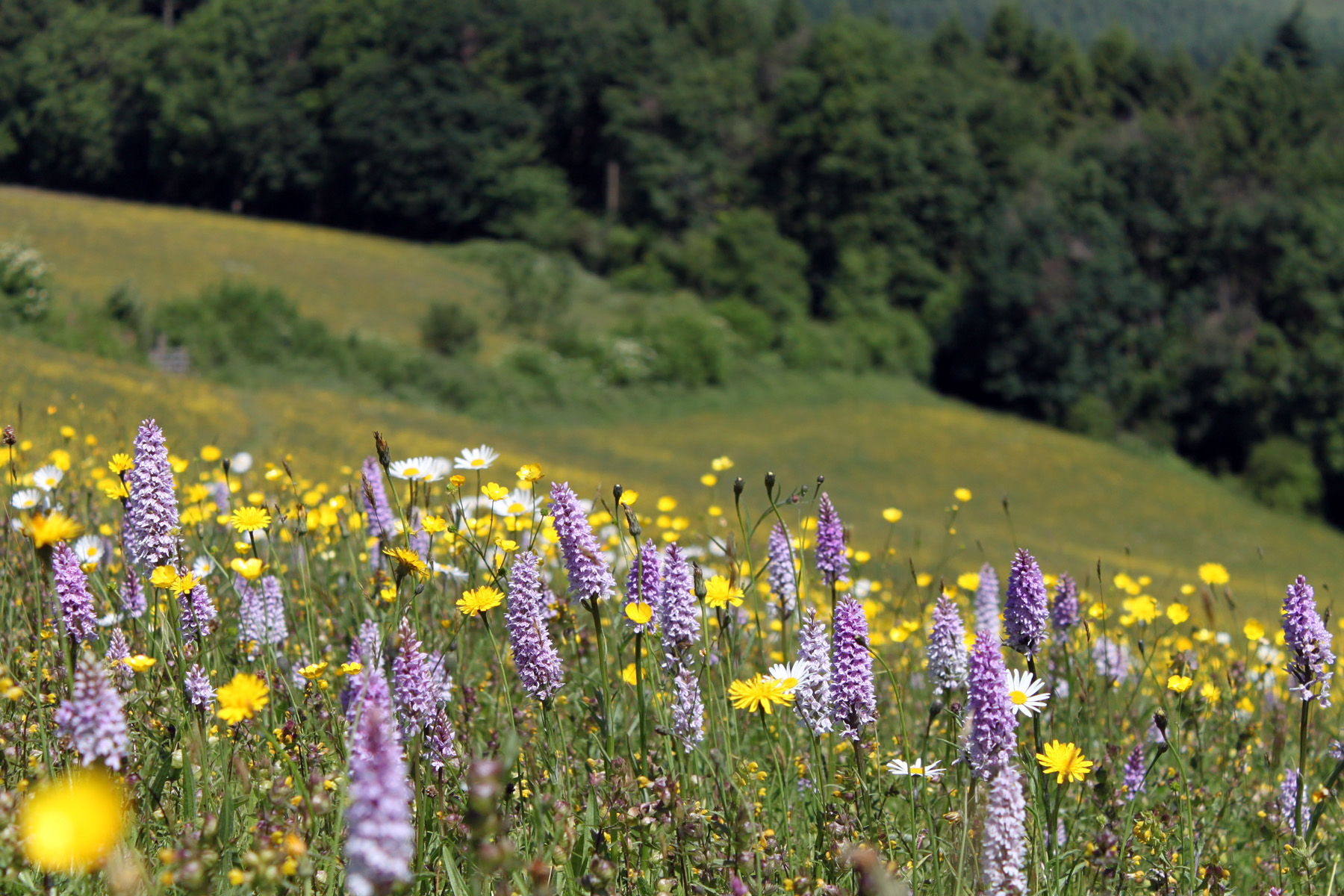
We are often asked why there has been a growing focus on livestock-centred talks and sessions within our work. For us, the answer is straightforward: grasslands and livestock are inseparable, each supporting and strengthening the other’s health and resilience. Hay meadows are carefully managed habitats which produce nutrient-dense forage for ruminants. Without the annual cutting and removal of hay, these meadows would quickly turn to scrub, and the rich and unique botanical diversity would be lost. In return, this diversity provides farm animals with essential minerals, micronutrients and natural anthelmintics. Whilst some of the science is still developing, there is evidence that plant compounds consumed by livestock also enrich the nutrient density of their products, which ultimately we all consume.
And so, beyond providing technical expertise and guidance for grassland restoration, we aim to connect the dots between a beautiful flower-rich meadow and the chunk of cheese or the beef burger on the plate. These elements have always been intrinsically linked – we simply need to remind ourselves of that.
