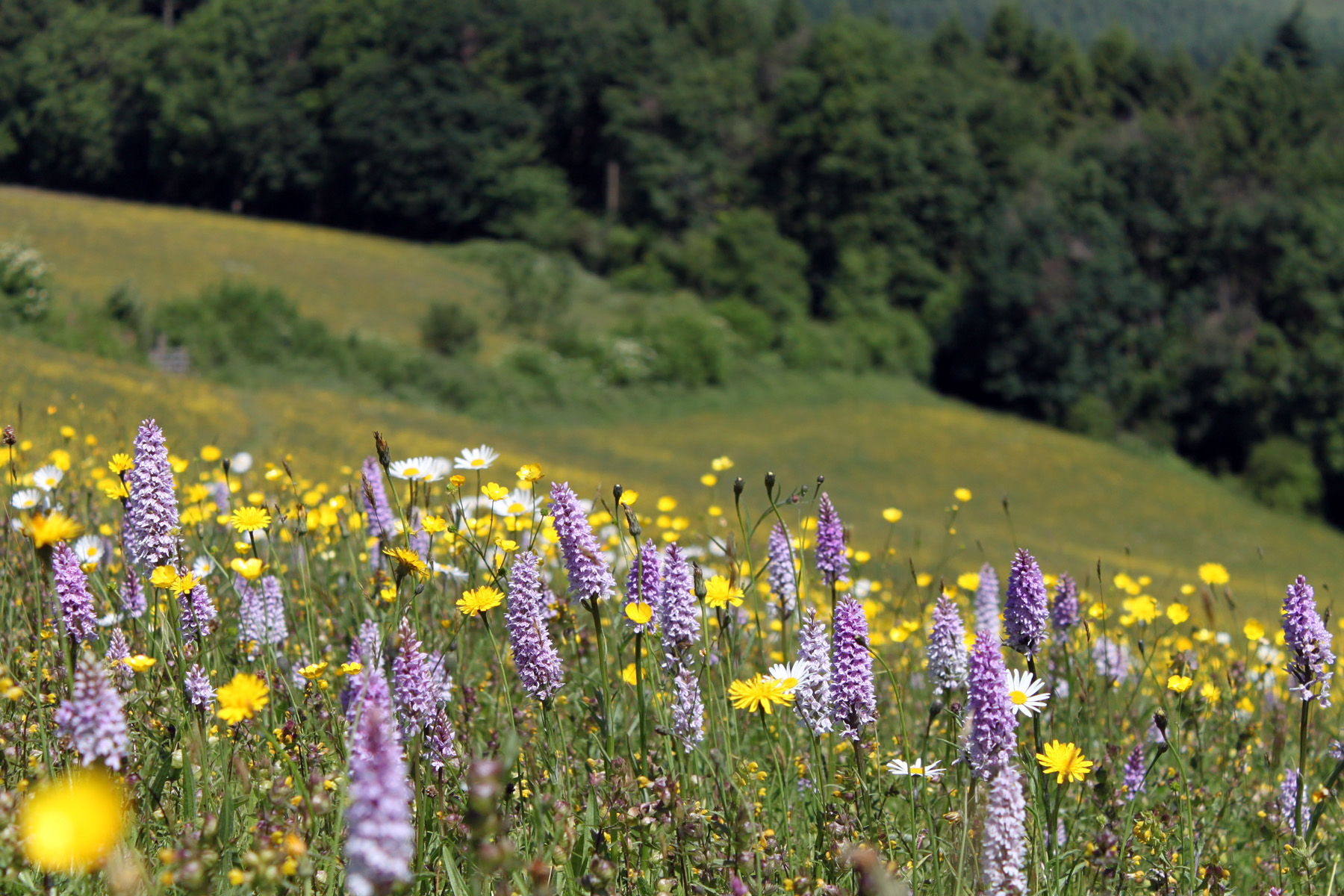

On Wednesday 3rd December, in a welcome break between what felt like weeks of rain, we gathered with a group of farmers and land managers at Bitterly Hyde, courtesy of hosts Camilla and Henry Dangerfield, to discuss winter management of newly restored grassland and to have a go at identifying emerging seedlings. Species-rich grasslands play a significant role in improving soil’s water infiltration rates and its water storage capacity. A diverse mixture of species creates a variety of rooting depths, forming channels through the soil and storing carbon exudates at different levels. This not only benefits biodiversity but also contributes to natural flood management.

Bitterly Hyde is situated in the Bodenham Brooks priority sub-catchment, one of the 7 areas covered by the Herefordshire Natural Flood Management (NFM) Project, which offers funding for implementation of natural processes and land-management measures to slow the flow of water and store more of it upstream, helping to reduce flood risk downstream. This includes improving soil infiltration through better soil management, using features like leaky dams to slow water movement, and creating or enhancing ponds, wetlands, and other areas that temporarily hold water before it is released slowly. Restoring species-rich grassland on fields that, due to their topography, are prone to losing water quickly through run-off is also an excellent way to slow water movement, with an added benefit of improving biodiversity.

Every restoration starts with site evaluation – the most important criteria are nutrient levels and existing sward diversity, with the limiting factors being high phosphate levels (above P Index 2) and high concentration of perennial weeds such as docks and creeping thistles. Most of the attendees had carried out recent restorations on sites we had previously assessed, and the session was designed to give them confidence in monitoring their restoration progress.
Looking for seedlings in the existing sward highlighted the importance of small areas of bare ground, timing, and adapting grazing management. Some of the bare patches created during restoration preparation remained visible, providing an ideal place to observe new seedlings. In the working meadow, such areas can be created by grazing and moving cattle and naturally reseeded from existing wildflowers and grasses. Maintaining sward height at 2.5–5 cm (1–2 inches) allows the young plants to receive enough sunlight for successful establishment.

The group compared observations and shared thoughts on the challenges of overseeding, as well as grazing strategies that best support species-rich grassland. It was reassuring to reflect together on the length of the restoration process: it is very much a marathon, not a sprint. Although it was disappointing not to spot more of the species introduced a few months ago by broadcasting seed, the exercise offered only a snapshot in time and reminded us how variable early establishment can be. We saw seedlings of yarrow, knapweed, meadow buttercup and cat’s-ear. Certain plants, such as yellow rattle, require vernalisation to germinate, so we would not expect to see them until February or March next year.
To help with your own seedling safaris, our Herefordshire Meadows seedling ID chart can be found on our Meadow Restoration resources page. Information how to apply for the Herefordshire Council NFM funding can be found here.